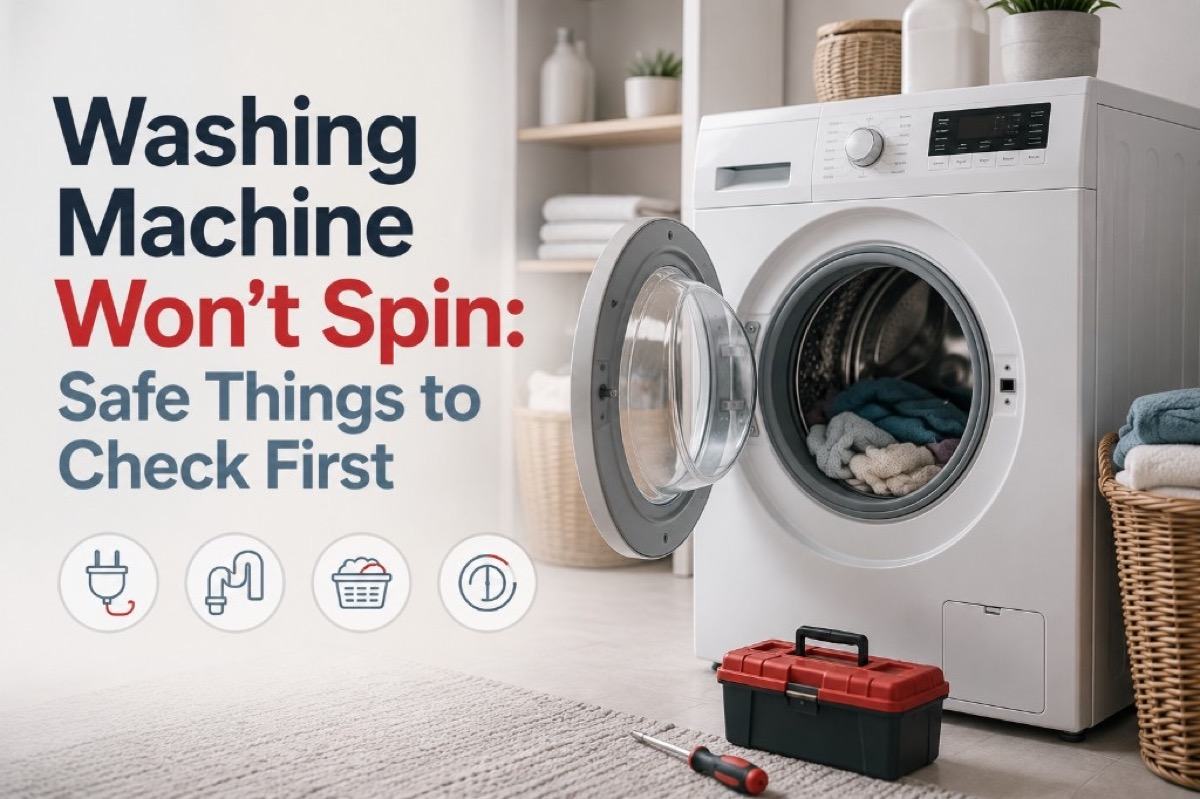
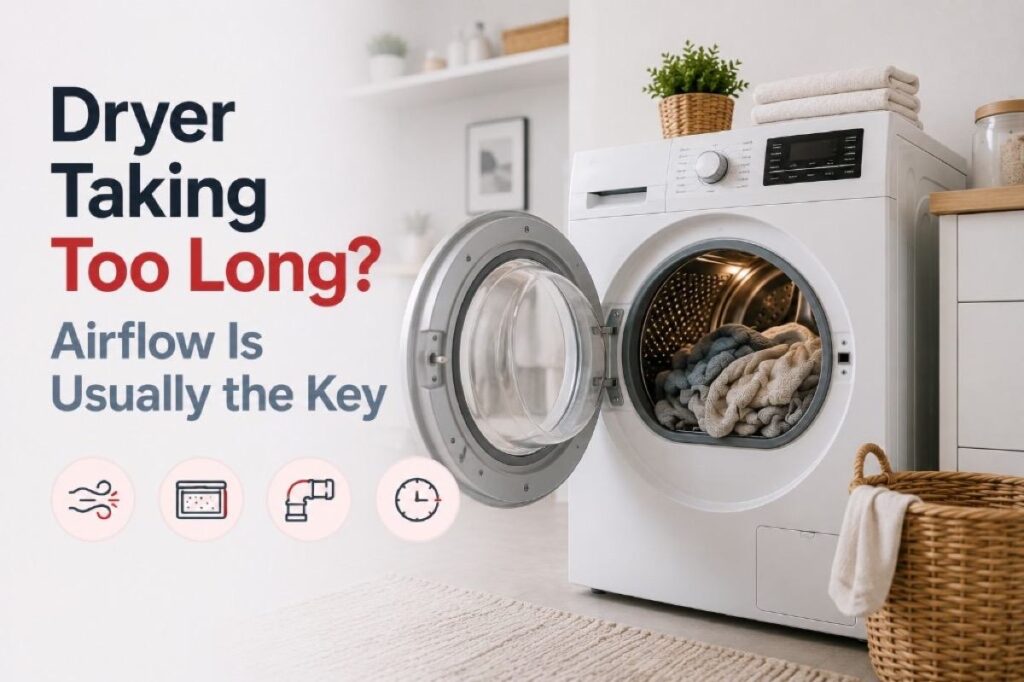
A washer that will not spin is often responding to something it can see, such as an unlatched door or lid, an unbalanced load, a slow-spin cycle setting, or too many suds. Check those first, then check whether the washer drained, because many washers reduce or skip the spin when water is still in the tub.
A Whirlpool washer that stops short of spinning leaves behind a heavy, soggy load, and that symptom by itself does not identify a broken part. Begin with safe, repeatable observations worth recording in case you later arrange service.
Basic care comes first, and testing or disassembly is work for someone else. A door lock, a safety switch, or a displayed message is there for a reason, so leave each one intact instead of forcing the machine to run. Observations written down today make the diagnosis more accurate tomorrow.
Start with the simple conditions
Spread out an uneven load, take a few of the heaviest items out, and confirm the water has drained before selecting a single rinse-and-spin as a test. Leave the washer where it stands and do not force panels, fittings, or controls. If a simple change makes a difference, run one normal cycle before deciding what it means.
A washer may reduce or skip the high-speed spin as self-protection when the drum is off balance or water is still in it. Pay attention to whether this occurs every time, only for certain loads or settings, or after the washer has been running a while; that tells you more than restarting it again and again.
| What you notice |
Probable cause |
Owner check |
| Load thumping around |
Uneven weight |
Spread the laundry out |
| Clothes left soaked |
Water not draining |
Clean the filter if you can reach one |
| Drum will not spin |
Fault inside the machine |
Note how the program behaves |
Which cycle settings look like a spin fault?
Whirlpool’s front-load guidance points out that Low or No Spin settings remove less water, while Drain and Spin extracts more. Cycle spin settings can be remembered from the last use, and delicate or hand-wash cycles spin slowly by design. A damp load after one of these cycles is the setting working as chosen.
Suds are another trigger. Using only HE detergent in the amount the manual specifies helps, because excess suds can interfere with drainage and rinsing.
Safe checks that protect the appliance
For the controls, filter access, and maintenance intervals of your particular washer, the use-and-care manual is the reference. Clean only the parts it identifies as user-serviceable, with recommended products, and reinstall anything removable in its intended position.
Clear obstructions first, then shed some weight from an unusually heavy load and make sure air, water, and the door are free to do their jobs. Frequent resets are a bad habit; they can cover up a fault that is intermittent and may leave water, heat, or pressure in a place it does not belong.
- Keep a record of any code or message shown, taken before you clear it.
- Check hoses, vents, seals, and plugs that are in plain sight, leaving electrical connections where they are.
- Try one controlled test, not a sequence of immediate repeats.
Checks you can make
- Even out the load
- Look at the drain path you can reach
- Run one spin cycle
Beyond owner level
- Get into the motor compartment
- Defeat the door lock
- Tug at the drive belt
What does a washer do with an unbalanced load?
On top-load models, Whirlpool describes an automatic response to an unbalanced load: the washer first tries to correct itself by adding water and rocking the basket, and may show an error if it cannot. Out-of-balance loads cause noise, vibration, and reduced spin speed.
Avoid washing a single bulky item alone, and avoid overloading. An unlevel washer also causes imbalance, noise, and vibration, so check that all four feet are firm.
Know when the symptom needs diagnosis
Basic checks that change nothing are the signal to leave the rest to a professional. Anything touching control boards, internal wiring, pumps, motors, heating circuits, gas connections, and refrigerant lines needs the correct equipment and a technician who can check that the repair is safe.
Arrange for a technician sooner rather than later when the washer is getting worse, trips a breaker, leaks near electrical parts, smells hot or burnt, grinds in a way it did not before, or cannot complete an ordinary cycle. If a safety warning appears, stop running it.
Which codes are tied to spin trouble?
Whirlpool’s front-load code page lists F5 E2 for a door that is not locking, F7 E1 for a motor speed error (check that the shipping bolts were removed and the load is not too large), and F9 E1 for a drain that takes too long. Top-load HE models show messages such as LdL (lid will not lock), Ofb (unbalanced), OL (load too large), and drn (not draining).
Exact messages vary by model. For an F-and-E code that is not listed, Whirlpool says to unplug the washer for five minutes, reselect the cycle, and book service if it returns.
What to tell the technician
Give the model number and describe exactly what happens, when it began, which settings were picked, and how the safe checks went. A picture of a displayed code or a short note about a noise helps too; do not remove a cover for either.
Washer spin questions
Why do my clothes come out of the washer sopping wet?
Check that the cycle was not set to a low or no spin, that the load was not unbalanced, and that the washer drained. If it still ends wet on a normal cycle, book a diagnosis.
Do front-load washers have anything to remove at install?
Whirlpool’s guidance says shipping bolts must be removed before a front-load washer is used, and a motor speed code can point to bolts left in place.
What if the washer pauses and restarts during spin?
That may be the balance correction at work, adding water and rocking the basket. Stopping the cycle and redistributing the load is the simple response.
Close observation is no repair in itself, though it is where to start. Correct the simple conditions, keep any useful error information on hand, and pass wiring, gas, sealed-system, and mechanical work inside the washer to a qualified technician.