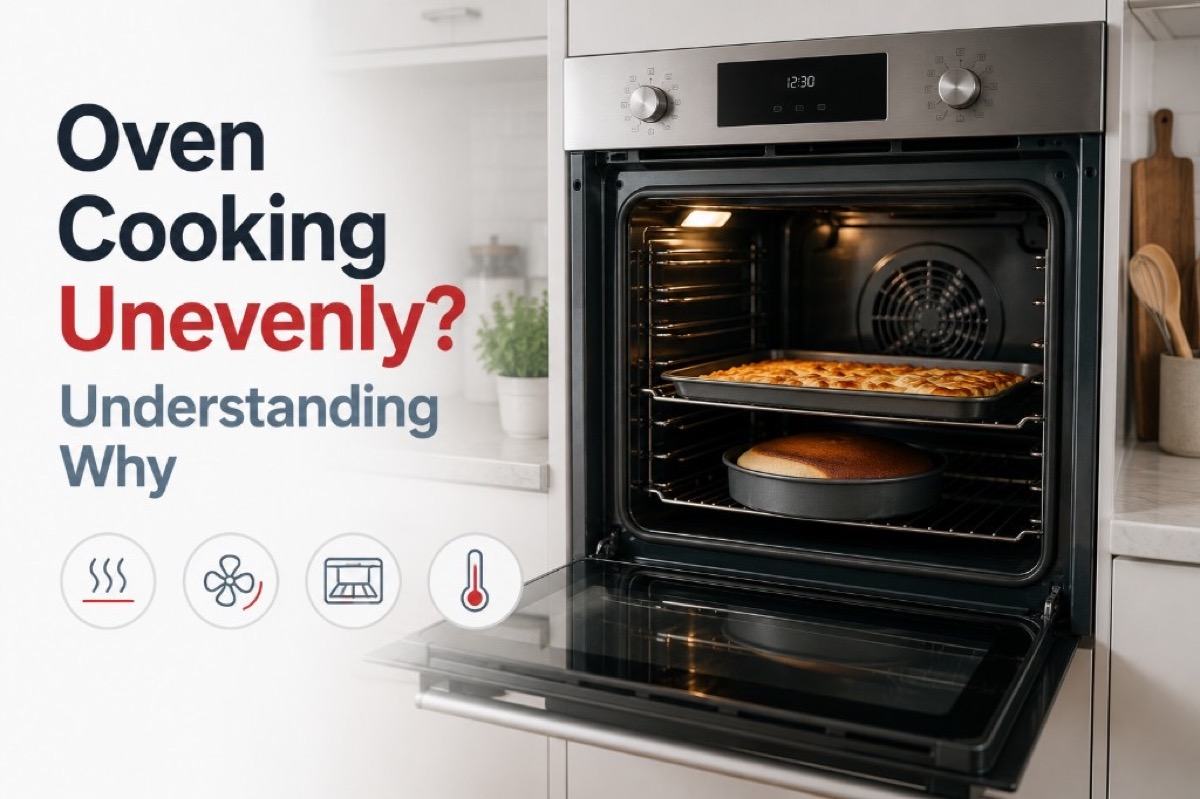
An oven that cooks unevenly is usually reacting to how it is being used, so check that it is level, fully preheated, loaded with the right pans, and not opened repeatedly. If food still browns unevenly after those changes, a temperature test can show whether the oven is running off its setpoint.
An oven that cooks unevenly can be frustrating, especially when it interrupts a normal household routine. A symptom alone does not identify a failed part, so start with observations that are safe, repeatable, and useful if you later arrange a Whirlpool service visit.
This guide separates routine care from work that requires testing or disassembly. Do not bypass a lock, safety switch, or error message to keep an appliance running. Taking a few notes now can make the eventual diagnosis faster and more accurate.
Start with the simple conditions
Preheat fully, use a center rack where the recipe allows, and avoid oversized pans or crowded trays that block airflow. Make the check with the appliance in its normal position and without forcing panels, fittings, or controls. If the result changes after a simple adjustment, run one normal cycle or operation before drawing a conclusion.
Results that differ only with one recipe may be a technique issue, while one side consistently undercooking can justify a temperature diagnosis. Look for a pattern: whether the issue happens every time, only with a particular load or setting, or after the appliance has been running for a while. That distinction is more valuable than repeatedly restarting the appliance.
| Result |
Likely cause |
Safe check |
| Uneven browning |
Crowded airflow |
Use one centered tray |
| Slow baking |
Not fully preheated |
Wait for ready signal |
| Large temperature gap |
Sensor or element |
Book testing |
Pans, racks, and foil that change browning
Whirlpool’s baking guidance notes that dark pans brown more than shiny ones, and that pale bottoms may improve with a lower rack. Cooking before the oven has finished preheating can leave tops over-browned and bottoms undercooked. Frequent door openings let heat escape and make results less even.
Foil also matters. Whirlpool advises against lining the oven bottom with foil or a liner, which can permanently damage the finish. Foil on the rack below a dish should extend at least half an inch beyond the dish, and it should never cover the whole rack.
Safe checks that protect the appliance
Consult the use-and-care manual for model-specific controls, filter access, and maintenance intervals. Clean only parts described as user-serviceable, use the recommended cleaning products, and refit every removable part exactly as it was designed to sit.
Before trying another cycle, clear obstructions, reduce an unusually heavy load, and make sure airflow, water supply, or door clearance is not being restricted. Avoid repeated resets: they can hide an intermittent fault and may leave water, heat, or pressure where it should not be.
- Record any displayed message or error code before clearing it.
- Check visible hoses, vents, seals, and plugs without moving electrical connections.
- Use one controlled test rather than several back-to-back attempts.
- Confirm the oven is level, since an unlevel oven can skew browning from side to side.
Safe to try
- Adjust rack position
- Use correct cooking mode
- Preheat fully
Leave to a technician
- Remove heating elements
- Test live voltage
- Force the door latch
A simple biscuit test for oven temperature
Whirlpool describes a test with refrigerated biscuits: bake them on the middle rack with about 2 inches of clearance from the walls, preheat until the tone sounds (or for 12 minutes if the oven has no indicator), and lower the temperature by 25°F if using dark pans. Compare the browning from one side of the pan to the other.
Even browning across the biscuits suggests the oven distributes heat well. Uneven browning suggests the cause may be airflow, loading, or temperature, and that is a reason to run the test again with only the pan in the oven.
Know when the symptom needs diagnosis
If the basic checks do not change the symptom, stop at the user-serviceable boundary. Internal wiring, heating circuits, pumps, motors, refrigerant lines, gas connections, and control boards need the correct test equipment and a technician who can verify the repair safely.
Arrange service promptly when performance is getting worse, the appliance trips a breaker, leaks near electrical parts, smells hot or burnt, makes a new grinding noise, or cannot complete a normal cycle. Do not continue operating an appliance that gives a safety warning.
What calibration can and cannot do
Select Whirlpool models let you adjust oven temperature calibration. The guidance is to change it by no more than 10°F at a time and retest after each change, so one adjustment does not stack on top of another.
Calibration shifts the average temperature. It does not fix hot spots, a door that does not close properly, or an oven that is out of level. If the test shows a large gap, or one side keeps undercooking, the oven needs testing by a technician, not a series of manual adjustments.
What to tell the technician
Share the model number, the exact symptom, when it began, what settings were selected, and the results of the safe checks above. A photo of a code or a short description of the sound can also help, but never remove a cover to obtain it.
Oven browning questions
Why does the top of my food brown before the bottom cooks?
Whirlpool lists insufficient preheating as a cause of over-browned tops and undercooked bottoms. Dark pans can also brown faster, so try a shiny pan or a lower rack.
Should I adjust the oven temperature setting?
Only if the manual says your model supports it, and only in small steps after a controlled test. Whirlpool’s guidance is to change by no more than 10°F at a time and retest.
Can I line the oven bottom with foil to catch drips?
Whirlpool advises against it because it can damage the oven’s permanent finish. Use a pan on a lower rack to catch spills.
Careful observation is not a substitute for repair, but it is the best first step. Address the simple conditions, preserve any useful error information, and leave electrical, gas, sealed-system, and internal mechanical work to a Whirlpool technician.