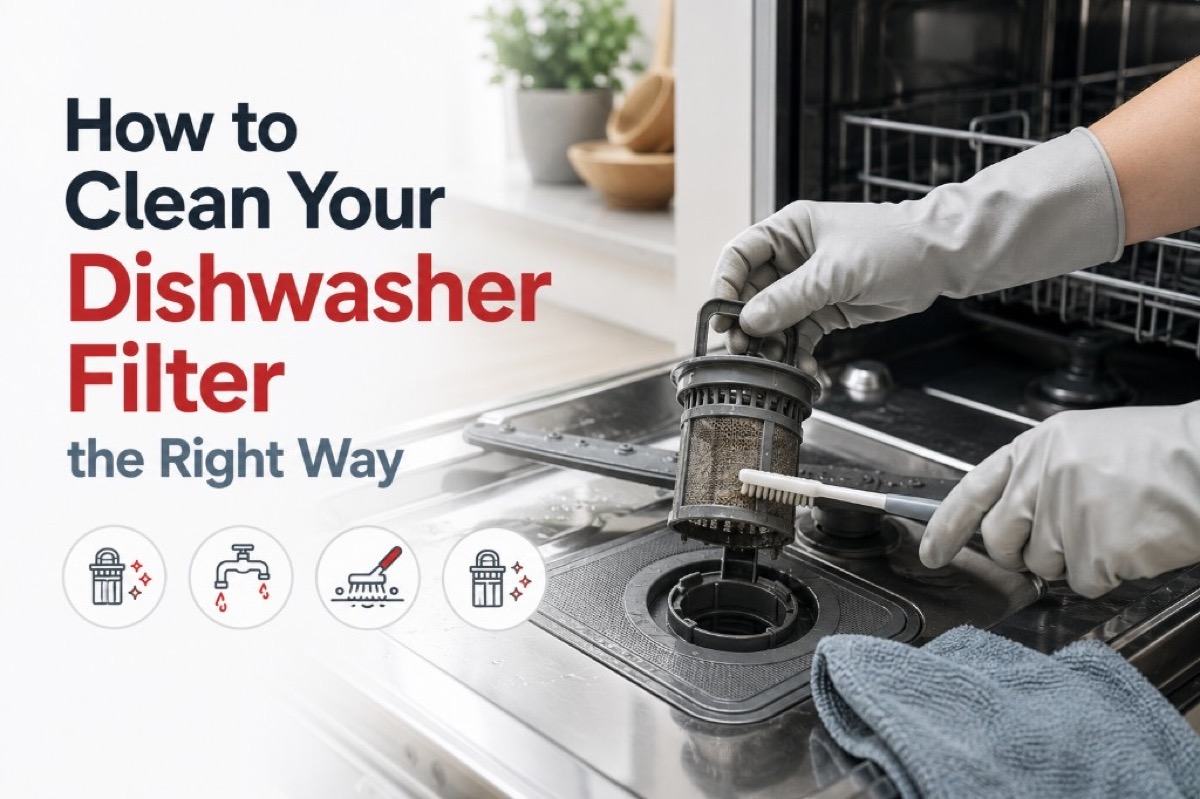
Cleaning a Whirlpool dishwasher filter means removing the filter pieces the manual describes, rinsing them under running water, brushing off stubborn residue gently, and refitting them so they lock in place. Never run the dishwasher without the filters installed.
Cleaning a dishwasher filter can be frustrating, especially when it interrupts a normal household routine. A symptom alone does not identify a failed part, so start with observations that are safe, repeatable, and useful if you later arrange a Whirlpool service visit.
This guide separates routine care from work that requires testing or disassembly. Do not bypass a lock, safety switch, or error message to keep an appliance running. Taking a few notes now can make the eventual diagnosis faster and more accurate.
Start with the simple conditions
Wait until the dishwasher is off and cool, then use the manual to locate, twist, and lift the filter only as instructed. Make the check with the appliance in its normal position and without forcing panels, fittings, or controls. If the result changes after a simple adjustment, run one normal cycle or operation before drawing a conclusion.
Food debris in the mesh or filter housing can reduce cleaning and drainage, particularly in homes that do not pre-rinse dishes. Look for a pattern: whether the issue happens every time, only with a particular load or setting, or after the appliance has been running for a while. That distinction is more valuable than repeatedly restarting the appliance.
| Task |
How often |
Method |
| Rinse filter |
Monthly |
Warm water |
| Brush debris |
As needed |
Soft brush |
| Check housing |
Each cleaning |
Wipe gently |
How the filter system is built
Many Whirlpool dishwashers use a triple-filter system with an upper filter assembly and a lower filter. Whirlpool’s cleaning page describes lifting the lower filter slightly and pulling it forward, and turning the upper assembly a quarter turn before lifting it out. Direction and release differ by model, and Whirlpool’s own pages do not all agree, so follow the manual for your dishwasher.
The filters catch food soil so it is not recirculated onto dishes or pushed toward the drain pump. When they clog, you may see gritty dishes, residue on the filter, a sour odor, or weaker cleaning.
Safe checks that protect the appliance
Consult the use-and-care manual for model-specific controls, filter access, and maintenance intervals. Clean only parts described as user-serviceable, use the recommended cleaning products, and refit every removable part exactly as it was designed to sit.
Before trying another cycle, clear obstructions, reduce an unusually heavy load, and make sure airflow, water supply, or door clearance is not being restricted. Avoid repeated resets: they can hide an intermittent fault and may leave water, heat, or pressure where it should not be.
- Record any displayed message or error code before clearing it.
- Check visible hoses, vents, seals, and plugs without moving electrical connections.
- Use one controlled test rather than several back-to-back attempts.
Safe to try
- Rinse with warm water
- Use a soft brush
- Refit filter securely
Leave to a technician
- Use sharp tools
- Run without the filter
- Reach into the pump area
Cleaning and refitting without damage
Rinse the pieces under running water. For hard-water calcium deposits, Whirlpool recommends a soft brush. A wire brush or scouring pad can damage the mesh, so avoid them. Clear the housing the filter sits in as far as you can see without reaching into the pump area.
When you put the filters back, Whirlpool notes the upper assembly is locked only if it does not turn freely. A filter that is loose or sits crooked can let debris through. If a piece will not seat, do not force it; check the manual’s diagram and look for stray debris underneath.
Know when the symptom needs diagnosis
If the basic checks do not change the symptom, stop at the user-serviceable boundary. Internal wiring, heating circuits, pumps, motors, refrigerant lines, gas connections, and control boards need the correct test equipment and a technician who can verify the repair safely.
Arrange service promptly when performance is getting worse, the appliance trips a breaker, leaks near electrical parts, smells hot or burnt, makes a new grinding noise, or cannot complete a normal cycle. Do not continue operating an appliance that gives a safety warning.
What a clean filter does not fix
A clean filter helps with soil and gritty residue, but it is not a cure for every drainage or cleaning complaint. If water still stands after cleaning, the restriction may be farther along, in the drain hose, a garbage disposal connection, or an air gap, or the pump itself may be at fault. Whirlpool lists these as separate causes of a long-drain error on some models.
Some models also have a clean-filter indicator. Where one exists, the manual says how to clear it after cleaning. Do not clear it without actually cleaning the filter, because it then stops being a useful reminder.
What to tell the technician
Share the model number, the exact symptom, when it began, what settings were selected, and the results of the safe checks above. A photo of a code or a short description of the sound can also help, but never remove a cover to obtain it.
Dishwasher filter questions
How often should I clean the dishwasher filter?
Whirlpool’s sources give different intervals, and the right schedule depends on the model and how much you run it. Heavy use and unscraped plates call for more frequent cleaning. Use the interval printed in your manual.
Can I run the dishwasher without the filter?
No. Whirlpool says never to run the dishwasher without the filters properly installed, because soil can reach the pump and drain path.
Is a gritty film on dishes always a dirty filter?
A clogged filter is one cause. Detergent, water hardness, loading, and spray-arm blockage can also leave film, so check the filter first and then look at the other factors before suspecting a failed part.
Careful observation is not a substitute for repair, but it is the best first step. Address the simple conditions, preserve any useful error information, and leave electrical, gas, sealed-system, and internal mechanical work to a Whirlpool technician.