Stop and call for help whenever a symptom involves a gas smell, burning, wiring, water near electrical parts, or the sealed cooling system. Owner work should stay on the outside of the appliance: cleaning what the manual calls user-serviceable, checking settings, and shutting off power or water if conditions are unsafe.
It helps to know in advance where homeowner repair ends. A symptom on its own never identifies a failed part, so rely on observations that are safe, repeatable, and worth passing along if you later arrange a Whirlpool service visit.
Homeowner care ends where measurement or disassembly begins. Defeating a lock, a safety switch, or a warning message to keep a machine going is not an option. Writing down what you notice makes any later diagnosis faster and more reliable.
Start with the simple conditions
Decide first whether the symptom has to do with heat, electricity, gas, water close to wiring, or a sealed cooling system, ahead of any routine check. Keep the appliance in its normal spot and do not force panels, fittings, or controls. If a simple adjustment changes what happens, run one normal cycle or operation before settling on a conclusion.
Anything that means taking off a panel, bypassing a safety device, or taking a live measurement is not a do-it-yourself job. Look for a pattern as well: every time, only with a certain load or setting, or only after a stretch of running? Knowing which is more useful than restarting the appliance repeatedly.
| Red flag |
Response |
Do not |
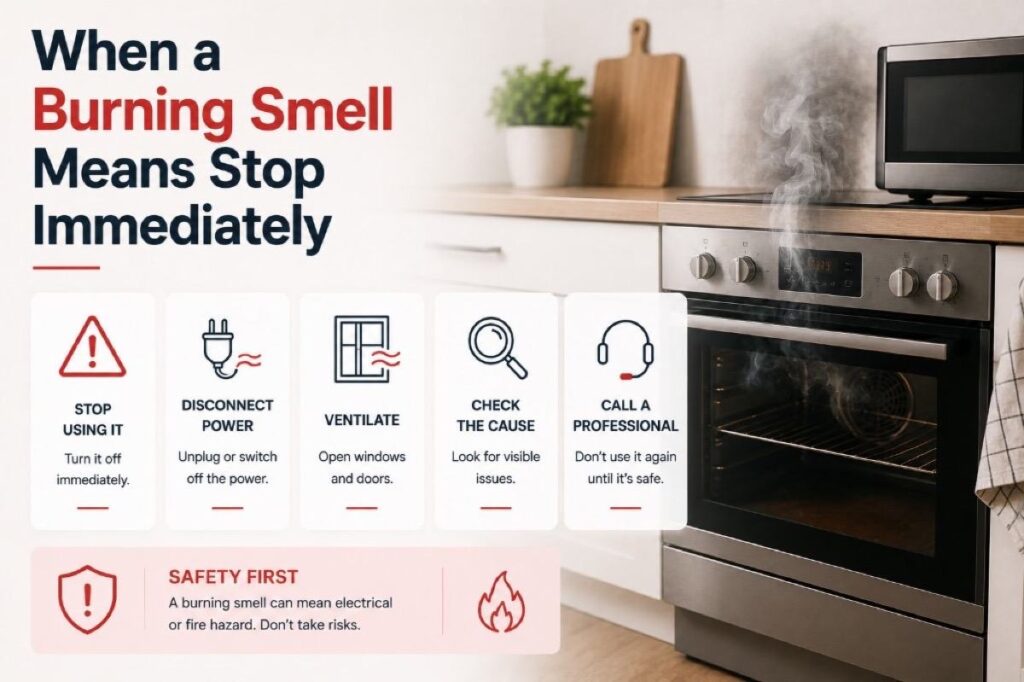
| Smell of burning |
Stop using it |
Take the appliance apart |
| Smell of gas |
Get out and call the gas supplier |
Flip switches |
| Water near an outlet |
Cut power safely |
Handle a wet plug |
Why are smell and sight not enough with gas?
General gas-safety guidance, repeated in Whirlpool manuals for gas ranges, is to avoid lighting any appliance, avoid touching electrical switches, and avoid using a phone inside the building if you smell gas. Leave, then call the gas supplier or the fire department from outside or from a neighbor’s phone.
The same manuals note that a gas leak cannot always be detected by smell, and they mention a gas detector as an added precaution. Whirlpool also says gas connections should be installed and repaired by a qualified or licensed installer. A gas smell is never a reason to investigate further yourself.
Safe checks that protect the appliance
The manual that came with a model is the place to confirm its controls, filter access, and maintenance intervals. Owners should clean only what it describes as user-serviceable, with the products it recommends, and refit each removable part exactly where it belongs.
Make sure nothing obstructs the machine, the load is not unusually heavy, and air, water, and door movement are free before any further try. Constant resets are risky because they can mask an intermittent fault and may trap water, heat, or pressure where it should never be.
- Before clearing an error code or message, jot it down.
- Examine whatever hoses, vents, seals, and plugs are in plain view, but do not move any electrical connection.
- Prefer a single controlled test over a series of tries one after another.
Within owner reach
- Clean filters the manual approves
- Look at connections you can see
- Read the manual first
Not for owners
- Work on gas fittings
- Probe energized parts
- Open a refrigerant circuit
Which electrical and water signs mean stop?
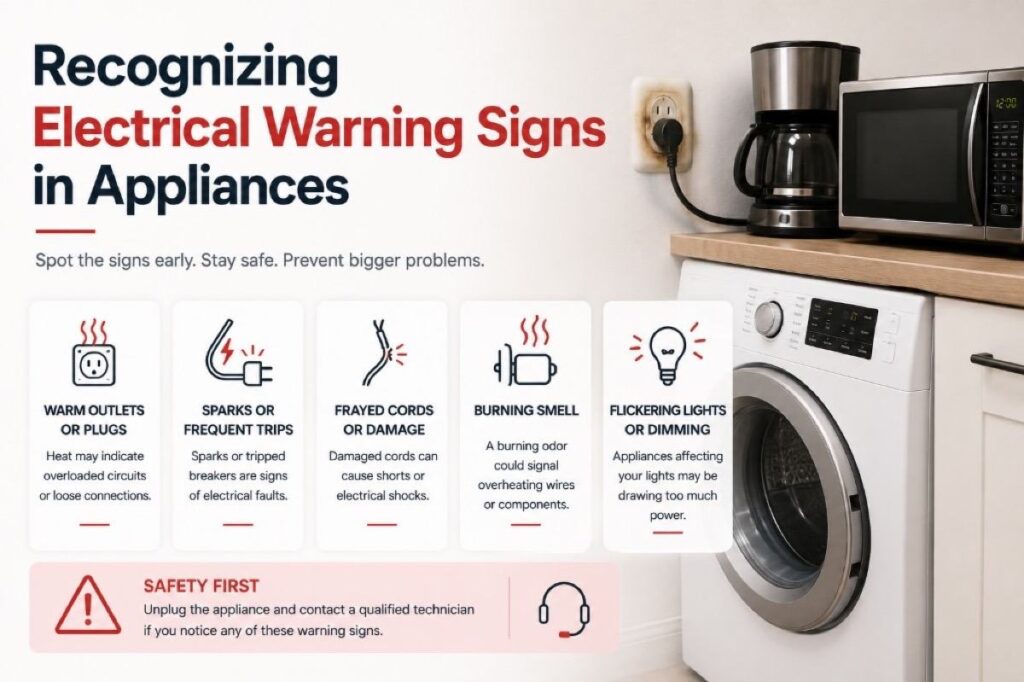
Whirlpool’s dishwasher guidance is direct: stop and call a technician if you smell burning, see damaged wiring, or find that the breaker trips repeatedly. Manuals for other appliances call for a grounded outlet and advise against extension cords or removing the ground prong.
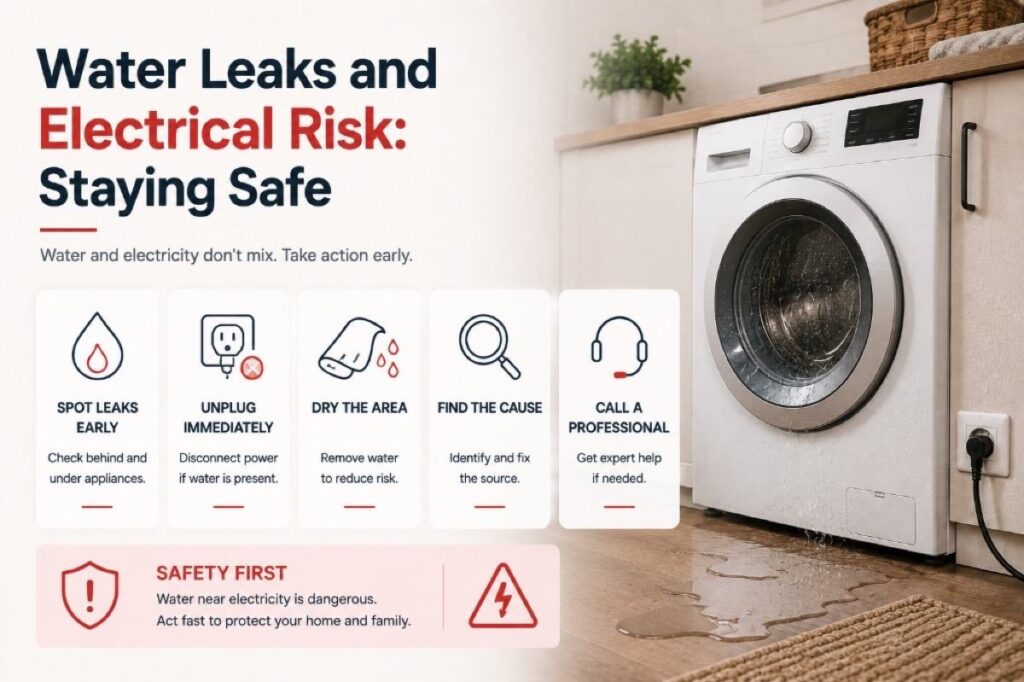
If a breaker trips, resetting it once is reasonable. If the problem continues, the guidance is to call an electrician. For a leak, Whirlpool’s guidance is to switch off the breaker, shut off the water, and not run the appliance until the source is fixed. Leaks near outlets or cords call for extra care: leave the plug alone and use the breaker.
Know when the symptom needs diagnosis
The moment basic checks fail to move the symptom, owner work is finished. Jobs on gas connections, internal wiring, control boards, heating circuits, motors, pumps, and refrigerant lines demand correct test equipment and someone qualified to verify the repair is done safely.
Service should be arranged right away when things are getting worse, a breaker trips, a leak is near electrical parts, a hot or burnt smell appears, a grinding noise is new, or an ordinary cycle will not complete. Never keep operating an appliance that shows a safety warning.
Which parts stay with a technician?
Some failures involve parts that cannot be tested safely without equipment and training. Whirlpool’s microwave guidance lists the magnetron and high-voltage diode as internal parts that need a professional. Pumps, motors, heating circuits, and control boards also sit behind panels that owners should not open.
The sealed refrigerant system is another line. A refrigerator that stops cooling after the safe checks are done needs diagnosis, not a repair attempt. Buying a part yourself does not remove the need for testing, safe access, and a correct fit.
What to tell the technician
Details worth giving: model number, precisely what happens, when it started, selected settings, and what the safe checks turned up. A photographed code or a few words describing a sound are welcome extras, obtained without taking any cover off.
Safety boundary questions
Is it safe to reset a tripped breaker?
Resetting once is generally acceptable, per Whirlpool’s electrical guidance. If it trips again, stop using the appliance and call an electrician or technician.
What should I do about water on the floor near the dishwasher?
Whirlpool’s leak guidance is to switch off the breaker, shut off the water supply, and keep the dishwasher off until the source is fixed. Do not touch wet plugs or outlets.
Is cleaning the filters and seals really all I should do?
Cleaning what the manual calls user-serviceable, checking settings, and clearing visible obstructions are the intended owner tasks. Anything that needs a panel removed, a safety device bypassed, or a live measurement is not.
Looking carefully cannot stand in for a repair; it simply comes first. Address the easy conditions, keep the error information, and let a qualified technician handle anything electrical, gas-related, or sealed-system, along with mechanical work inside the cabinet.